
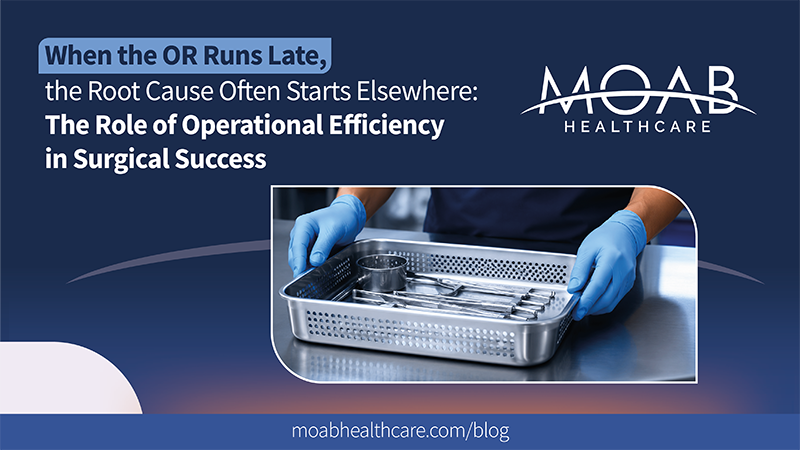
When the OR Runs Late, the Root Cause Often Starts Elsewhere: The Role of Operational Efficiency in Surgical Success
When healthcare leaders discuss operating room performance, the conversation often centers around case volumes, surgeon utilization, or first-case on-time starts. While these metrics are important, achieving sustainable success requires looking deeper at the operational systems that support them.
At its core, operational efficiency isn’t about doing more with less. It’s about ensuring that every process, every team, and every resource is aligned to support safe, timely, and high-quality patient care.
Too often, when operational efficiency begins to decline, the symptoms first appear in the operating room.
- Delayed case starts
- Frustrated surgical teams
- Increased overtime
- Rescheduled procedures
- Decreased patient satisfaction
But the actual root cause frequently lies elsewhere.
One of the most overlooked drivers of operational efficiency in healthcare is Sterile Processing.
When SPD faces staffing shortages, excessive tray inventory, aging equipment, workflow inefficiencies, or growing instrument backlogs, the downstream impact can be significant. A single unavailable surgical tray can delay a procedure. Hundreds of unavailable trays can disrupt an entire surgical schedule.
The challenge is that these disruptions don’t remain isolated to one department.
They affect surgeons trying to maintain schedules.
They affect OR teams working to keep cases moving.
They affect leadership attempting to balance productivity with patient experience.
Most importantly, they affect patients waiting for care.
Operational efficiency is often measured in metrics, but its true impact is felt in outcomes. Every delayed instrument set represents lost time, increased stress on caregivers, and potential delays for patients who have already coordinated transportation, time off work, and family support for their procedure.
There is also a substantial financial component.
Operating rooms are among the most expensive environments in healthcare. Every minute of downtime, every delayed case, and every cancellation caused by unavailable instrumentation creates avoidable costs. Organizations focused on operational efficiency understand that improving support functions such as Sterile Processing can generate significant returns throughout the surgical enterprise.
In fact, the return on investment can be far greater than many organizations realize. Improving instrument availability and reducing tray backlogs can increase surgical throughput, improve room utilization, reduce overtime expenses, and create additional case capacity without adding OR space or increasing headcount. When operational bottlenecks are removed, hospitals are often able to perform more procedures, improve resource utilization, and capture revenue that would otherwise be lost to delays and cancellations.
The ROI extends beyond financial performance. Greater operational efficiency improves surgeon satisfaction, reduces staff frustration and burnout, supports employee retention, and enhances the patient experience. When teams spend less time reacting to operational challenges, they spend more time focusing on delivering exceptional patient care.
The most successful facilities recognize a simple truth:
Operational efficiency is not an OR initiative.
It is an organizational initiative.
High-performing hospitals understand that Surgical Services, Sterile Processing, Supply Chain, Environmental Services, and Leadership are interconnected parts of a much larger system. When one area struggles, the entire system feels the impact. When one area improves, the benefits are shared across the organization.
I’ve seen firsthand how quickly operational momentum can shift when facilities address inefficiencies before they become crises. By focusing on process improvement, workflow optimization, staffing stability, and backlog reduction, organizations can restore consistency, improve staff morale, and create a better experience for patients.
The goal is not simply to work harder.
The goal is to work smarter.
True operational efficiency creates capacity. It reduces unnecessary delays. It strengthens teamwork. It allows clinical staff to focus on patient care rather than constantly managing operational obstacles.
As healthcare organizations continue to face workforce challenges, financial pressures, and increasing patient expectations, the question becomes:
Are we investing enough in operational efficiency behind the scenes to ensure exceptional patient care at the bedside and in the operating room?
The facilities that answer “yes” will be the organizations best positioned to deliver quality outcomes, support their teams, and thrive in an increasingly complex healthcare environment.
Because operational efficiency isn’t just about productivity—it is about protecting patient care, strengthening financial performance, and maximizing the return on every resource invested in the delivery of care.
By:
Bart Scott, RN
Executive Vice President of Clinical Operations
About Moab Healthcare