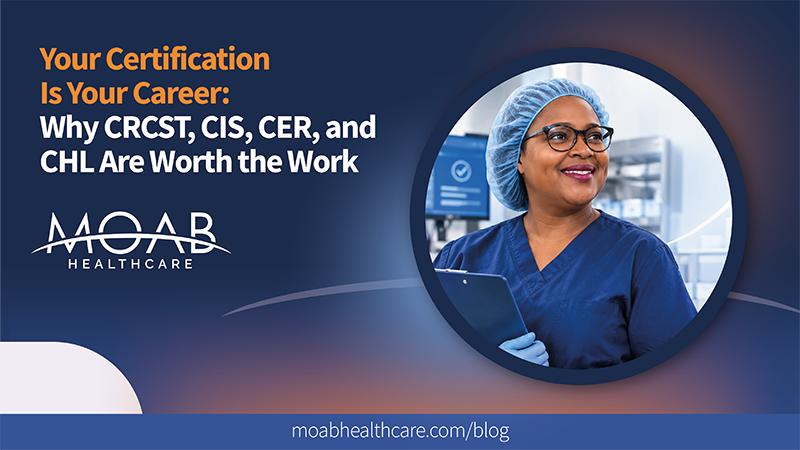
Your Certification Is Your Career: Why CRCST, CIS, CER, and CHL Are Worth the Work


I’ve spent more than 30 years in Sterile Processing, and if there’s one conversation I keep having with SPD professionals at every stage of their career, it’s this one:

“Is it really worth getting certified?”


I understand why people ask. Certification takes time, commitment, and often a personal financial investment. While some organizations offer reimbursement or educational support, many technicians pay for certification exams and continuing education out of their own pockets. And although certification is not a state requirement in many parts of the country, hospitals and healthcare systems may require it as a condition of employment, and professional standards organizations such as AAMI continue to recommend certification as a best practice for Sterile Processing professionals.

So let me answer the question clearly:

Yes, it’s worth it, and it’s worth more than most people realize.


Certification Is the Difference Between a Job and a Career

Early in my career, I watched two equally hardworking technicians take very different paths. One pursued certification early and continued building their career credentials. The other kept waiting for the “right time.”

 
A decade later, one was leading teams and advancing professionally. The other remained highly skilled but had fewer opportunities to demonstrate their expertise beyond the walls of that facility.
 
That’s the real purpose of certification. It translates experience into recognized professional achievement.
 
A resume that says “12 years of experience” is a claim. A resume that says “12 years of experience” backed by professional credentials such as CRCST, CIS, CER, or CHL is evidence.”
 

Building Your Professional Certification Pathway

CRCST: Your Foundation


CRCST establishes the knowledge every Sterile Processing professional needs. It validates your understanding of decontamination, sterilization, infection prevention, instrument processing, and quality standards.

For most professionals, this is where the journey begins.

CIS: Becoming an Instrument Expert


CIS focuses on advanced instrumentation knowledge and tray assembly expertise.

If you’re passionate about surgical instruments and want to become the person others rely on to solve complex instrumentation challenges, CIS is an exceptional next step.

CER: Specialized Expertise in Endoscope Reprocessing


CER focuses on Flexible endoscope processing and High-level disinfection.
It distinguishes you as a specialist in one of the most critical and high-risk areas of reprocessing.
 
CHL: Leading Departments and Teams

CHL focuses on leadership, department operations, staff development, budgeting, performance management, compliance, and quality systems.

It’s designed for professionals who want to move beyond technical excellence and into leadership roles that influence entire departments.

Whether your goal is supervisor, manager, educator, director, or executive leadership, CHL helps prepare you for that next step.
 
There Is More Than One Way to Grow
 

One of the biggest misconceptions I see is that every technician should follow the same career path.

That’s not true.

Some professionals pursue leadership through CHL. Others become instrumentation experts through CIS. Others develop highly specialized expertise through CER. Many pursue multiple credentials throughout their careers.
 
The important thing isn’t which certification you pursue next.
 
The important thing is continuing to grow.
 
Every credential expands your knowledge, strengthens your credibility, and creates opportunities that may not otherwise exist.
 
The Industry Needs Certified Professionals
 
Certification benefits individuals, but it also benefits the profession as a whole.
As Sterile Processing continues to evolve, certification helps establish consistent standards, strengthen patient safety practices, and elevate the professional recognition of SPD teams across healthcare organizations.
 
When healthcare leaders see certified technicians, they see professionals who are committed to excellence, accountability, and continuous improvement.
 
That’s powerful.
 
Where to Start
 
If you’re not yet certified, start with a plan.
 
Choose a certification goal. Identify study resources. Find a mentor. Block time on your calendar. Commit to an examination date.
 
Progress begins with a decision.
 
And if you’ve already earned certifications, consider investing in the next generation of professionals.
 
Some of the greatest moments of my career have been watching technicians develop confidence, earn credentials, and realize their potential as leaders and experts within our profession.
 
Your work directly impacts patient safety every day.
 

Certification helps ensure your expertise receives the professional recognition it deserves.
 
By Janet Tull, CRCST, CIS, CHL
VP of Sterile Processing Solutions, Moab Healthcare