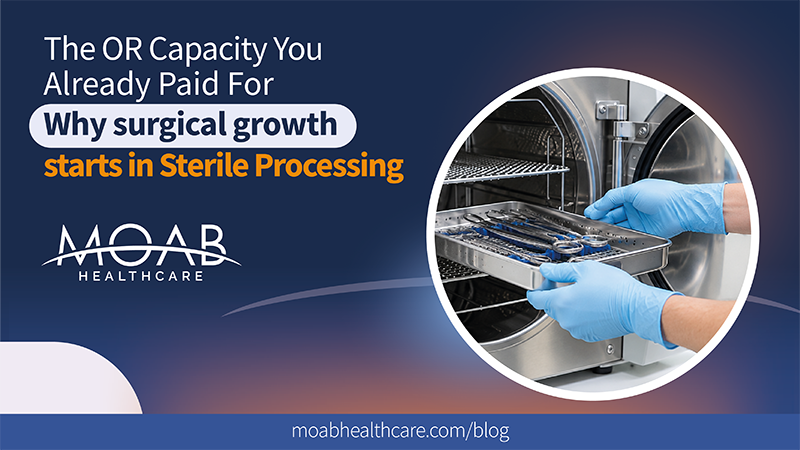
The OR Capacity You Already Paid For
Why surgical growth starts in Sterile Processing
As hospitals finalize 2027 budgets, most growth plans point to the same levers: new service lines, more surgeons, more square footage. Each one requires significant capital and years to pay back.
There is a faster lever, and it does not require new capital.
Hospitals are losing OR capacity they already paid for, and they are losing it in Sterile Processing.
This issue shows where that capacity goes, how to measure it, and how leading health systems are recovering it.
Where the Capacity Goes
Every surgical case depends on a complete, sterile, correctly assembled instrument tray arriving on time. When Sterile Processing falls behind, the OR waits. Waiting OR minutes are lost revenue.
These losses rarely appear on a finance dashboard. They show up as:
- First-case delays and late starts
- Paused cases while a missing or contaminated instrument is replaced
- Rescheduled procedures because trays are not ready
- Surgeon frustration that affects case volume and retention
- Survey findings and infection risk that carry financial and reputational cost
In our August issue, we cited research estimating that instrument-related delays cost roughly $200,000 per operating room each year. Because most SPD errors are never formally reported, the figure on any one hospital’s books is likely understated. The more useful question is what the number is for your hospital.
Run Your Own Number
Most hospitals have never put the cost of Sterile Processing performance in one place. The data exists, but it sits in different departments. Three inputs bring it together:
- OR minutes lost to instrument and tray issues, drawn from delay logs and first-case start data
- Cases delayed, rescheduled or cancelled for tray-related reasons
- Reprocessing volume: instruments processed compared with instruments actually used on high-volume trays
Multiply recoverable cases by average contribution margin per case, then add the reprocessing labor and supply cost of instruments that are processed but never used.
Example: 2 recovered cases per OR per month across 20 ORs = 480 additional cases a year
That growth requires no new construction and no new service line. It comes from capacity the hospital already owns.
The Proof
Health systems that treat Sterile Processing as a capacity lever are already recovering what they paid for.
- A large Florida health system: 4,000+ additional surgical cases per year with no added SPD headcount; 58 professionals onboarded in two months
- A Northeast academic medical center: Tray inventory reduced by nearly 36%
- A Mid-Atlantic regional hospital: Sterilization defects and SPD-related case delays significantly reduced through root-cause analysis and workflow redesign
None of these results required a new building or a new service line. Each came from capacity the hospital already owned.
Managing by Outcomes, Not Bill Rate
Our August issue examined how Managed Service Provider (MSP) staffing models are typically built around filling shifts at the lowest bill rate. That approach treats Sterile Processing as a labor cost to minimize.
The finance case points the other way. A lower bill rate saves little if turnover, retraining and late trays cost the OR hundreds of thousands of dollars a year.
The question for finance leaders is not “What does Sterile Processing cost per hour?” It is “How much OR capacity is Sterile Processing protecting or losing?”
The Fix: The 3-P Methodology
Moab Healthcare recovers lost capacity through its 3-P Methodology:
- People. Certified Sterile Processing professionals and leaders placed where performance depends on them.
- Process. Standardized workflows, optimized trays, clear SOPs and tracked KPIs that keep the department survey-ready.
- Protection. Lasting safeguards and self-auditing that sustain results after the engagement ends.
Moab is vendor neutral, so every recommendation is about the department, not a product. Moab is also a Vizient-approved supplier. The goal of every engagement is a team that runs on its own.
Start With the Number
Before committing 2027 capital to new capacity, find out how much your hospital already owns. A 3–5 day Moab Healthcare Sterile Processing Assessment measures where capacity is being lost and delivers a prioritized, dated roadmap to recover it.
Schedule a 20-minute conversation: hello@moabhealthcare.com | 833-773-8324
Moab Healthcare is a founder-owned Sterile Processing specialist: vendor neutral, Vizient-approved and focused exclusively on Sterile Processing staffing, training and leadership.