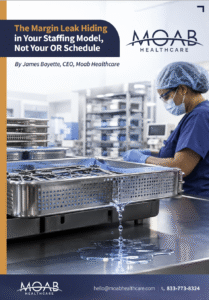
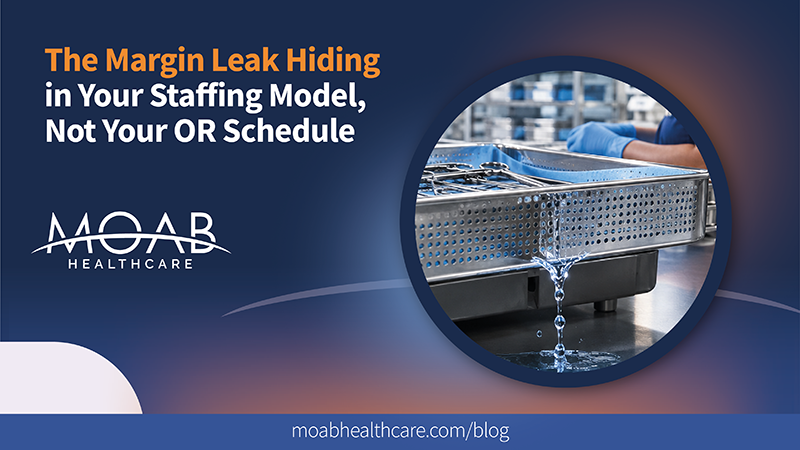
The Margin Leak Hiding in Your Staffing Model, Not Your OR Schedule
Most margin conversations in Sterile Processing start with the operating room: delayed cases, missing trays, lost chargeable minutes. That’s real, and it’s costly. But it’s not the whole picture, and it’s not even the most fixable part.
The bigger leak is upstream. It’s in the staffing model itself, and it shows up as a dozen small line items that never get rolled up into one number on anyone’s dashboard.
The Cost You’re Not Adding Up
When an SPD department is chronically understaffed or turning over technicians every few months, hospitals don’t just absorb that as a vacancy problem. They absorb it as a series of workarounds, and every workaround has a price tag:
- Loaner trays. When your own instrument sets aren’t ready or complete, you rent someone else’s. Loaner fees, expedited shipping, and the labor to process and return them on a tight window add up fast, and they’re almost always coded as a routine operating expense rather than a symptom of an understaffed department.
- Immediate-use steam sterilization (IUSS), used as a routine fix rather than an emergency exception. IUSS has a legitimate clinical purpose. It is not supposed to be a daily production strategy. When it becomes one, it’s usually because there isn’t enough trained staff to keep the normal cycle running on time, and it quietly increases both cost and risk.
- Agency and travel staffing premiums. Emergency staffing costs multiples of a stable FTE, and hospitals leaning on it long-term are effectively paying a permanent surcharge to cover a gap that never gets structurally addressed.
- Instrument damage and replacement. Rushed reprocessing, inexperienced hands, and inconsistent training all correlate with higher rates of instrument mishandling. Replacing or repairing surgical instruments is not cheap, and it’s a cost most finance teams never trace back to staffing instability.
None of these show up in the same place. Loaner fees sit in supply chain. Agency premiums sit in labor. Instrument repair sits in a capital or biomed budget. IUSS overuse rarely gets tracked as a cost at all. That’s exactly why this leak survives budget season after budget season: no single line item is alarming enough on its own to trigger a conversation, even though the sum of them often is.
Why This Is a Retention Problem, Not Just a Budget Problem
Here’s the part that should concern every CXO: this cycle is self-reinforcing. Understaffed departments push more work onto fewer people. Overworked technicians burn out and leave. Departments backfill with agency staff or rush new hires through training. Quality dips, workarounds increase, and the cycle repeats, now with a slightly larger price tag each time.
You cannot buy your way out of this with more loaner trays or more overtime. Those are the symptoms being treated, not the disease. The actual fix is investing in a stable, trained, adequately staffed core team, because a stable team is the only thing that reduces every one of those line items at once.
What This Means for How You Evaluate SPD
If you’re building next year’s budget, I’d encourage you to ask a different question than the one most hospitals ask. Not “how do we reduce SPD’s labor cost,” but “what is our current instability costing us across supply chain, labor, and capital combined.” In our experience, that number is almost always larger than what leadership expected, and larger than the investment required to fix it.
A properly staffed, well-trained SPD team is not a cost center waiting to be trimmed. It’s the thing standing between your hospital and a recurring, distributed tax on your margin that’s hard to see precisely because it’s spread across three different budgets.
Sterile Processing has always been a safety function. It’s time more finance teams also treated it as the financial function it clearly is.
James Boyette is CEO of Moab Healthcare, a founder-owned healthcare services company focused exclusively on Sterile Processing staffing, training, and leadership.